Case studies
See how assessment workflows change with BLANKSAGE.
A worked example of an evaluation run, told from problem to learnings. Institution case studies will be added here once they can be shared.
Example evaluation run
Evaluating a set of handwritten answers against a rubric
Client / use case
An example run, not a named customer: a set of handwritten answers evaluated against a marking rubric, then reviewed by an evaluator.
Problem
Marking handwritten answers by hand is slow, and the reasoning behind each mark is usually lost. The aim of this run was to evaluate a full set quickly while keeping a person in control of the final marks.
Workflow
Upload
Answer sheets go in.
Evaluate
Answers are scored against the rubric.
Review
An evaluator checks the results.
Correct
Corrections are recorded.
Upload
Answer sheets go in.
Evaluate
Answers are scored against the rubric.
Review
An evaluator checks the results.
Correct
Corrections are recorded.
Implementation
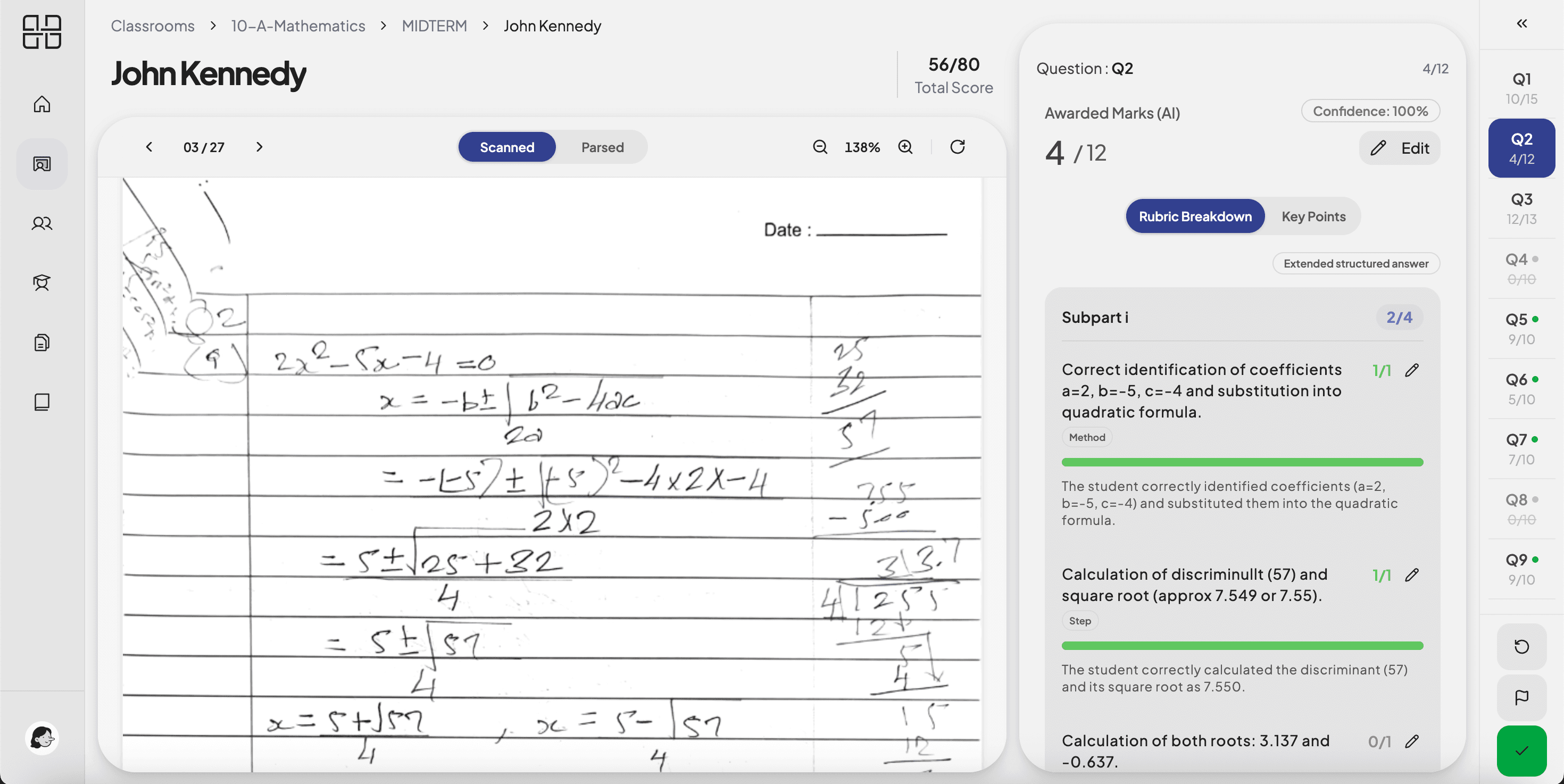
Answer sheets were uploaded, evaluated against the exam's rubric and reviewed by an evaluator using the review screen, where each mark can be edited, re-evaluated, flagged or approved.
Result
150
Answers evaluated
180
Seconds to evaluate
25
Corrections recorded
24
Corrections accepted
150 answers were evaluated in 180 seconds. During review, 25 corrections were recorded and 24 of them were accepted.
Learnings
- Review belongs in the workflow: the corrections that were recorded are the reason a first pass is not the final word.
- Not every correction is accepted (24 of 25 here), which is why an evaluator makes the final call.
- The value is in doing the first pass quickly, so evaluator time goes to the answers that need it.
Figures are from an example evaluation run and describe that run only.
Want your own worked example?
Bring a question paper and a sample of answer sheets. We will run an evaluation with you.